By Wednesday your LinkedIn calendar has gaps, your pipeline softens, and your best ideas sit half written. The solution is not more time. It is a repeatable system that turns your expertise into consistent posts, lead magnets, and meetings without diluting your voice.
This playbook shows how to stand up LinkedIn content automation that ships daily, captures qualified opt-ins, and gets smarter every week. The workflow uses LiFast where it matters so you run an end-to-end B2B funnel in minutes and spend less than 10 minutes per week on review.
Map your content pillars
Pillars focus your strategy and make scale possible. Start from buyer reality, not brainstorms. Paste your product or service URL into LiFast, run audience analysis, and capture three concrete outputs: who buys, what outcomes they own, and what objections stall deals. Translate that into three to five pillars you can sustain all year.
- Demand and problems. Name the job-to-be-done in your buyer’s words. Example: “Our SDRs burn time qualifying tire-kickers” becomes “Qualification you can trust without more headcount.”
- Use cases and playbooks. Teach a task end to end. Example: “Route LinkedIn lead gen forms to CRM in 10 minutes with enrichment and auto-assign.”
- Proof and stories. Before-and-after snapshots, mini tear-downs, and quick charts. Example: “From 0 to 14 inbound demos per week in 45 days. Calendar screenshot and 3 decisions that mattered.”
- Opinion and industry shifts. Explain what changed and what to do now. Keep it specific to your ICP’s world, not broad trend posts.
- Product in public. Share decisions, tradeoffs, and lessons from building your solution, tied back to buyer value.
How a SaaS founder should use LinkedIn for growth
Publish teaching-first content three to five times per week. Each Friday, ship one practical lead magnet that converts attention into a hand raise. LiFast generates targeted magnets from your URL and audience insights, delivers them as clean Notion files or polished PDF exports, and supports LinkedIn lead capture so buyers opt in without leaving the platform. Good weekly magnets: a 7-step onboarding checklist, a pricing objection script, or a 30-day content calendar template. Each should take a buyer from awareness to a small win in under 15 minutes.
Build prompt libraries
Prompts standardize quality and speed. Create a living library per pillar with five modules and usage notes. Store them where your team can update weekly based on results.
- Hook templates. Examples: “The most expensive week in B2B is the week you go silent.” “If I had to rebuild pipeline from zero, I’d do this for 30 days.” “Stop doing X. Do Y instead.”
- Point of view frames. Examples: “Automation should protect judgment, not replace it. Here is the 20 percent that ships 80 percent of the value.” “Playbooks beat silver bullets. Here is ours.”
- Proof snippets. Screenshots, metrics, and crisp anecdotes. Examples: “4 posts/week for 8 weeks led to a 62 percent lift in saves and 2x demo requests.” “Lead-to-meeting rate from 9.4 percent to 15.1 percent after adding a checklist magnet.”
- CTA patterns. Teaching post: “Want the template I use. Comment TEMPLATE and I will send it.” Magnet post: “Grab the 2-page guide. Link and instant access in the form.”
- Format rules. One idea per post. 1–2 line paragraphs. Plain verbs over jargon. Replace terms like “synergy” with “works well together.” Target a 6th–8th grade reading level.
When you generate content with LiFast, feed the relevant pillar plus these modules into AI post generation. Its voice learning keeps phrasing and cadence consistent, and unlimited regenerations let you replace only weak lines until the draft reads like you. Add a short “banned words” list and a “jargon to buyer-language” swap list to keep tone tight.
Build, schedule, and approve the weekly queue
Batching removes decision fatigue and raises the floor on quality. Protect a 45–60 minute block early in the week to generate, refine, and schedule a full queue.
- Ideas. Pull 8–12 ideas from LiFast’s post ideas generator, grouped by pillar. Sort by buyer impact and novelty. Mark two as video candidates if relevant.
- Drafts. Use AI post generation to create 6–8 posts. Apply your hook, point of view, proof, and CTA modules. Regenerate hooks until line one is clear, specific, and scroll-stopping without clickbait.
- Lead magnet. Create one weekly magnet in LiFast. Choose Notion delivery for interactive checklists or frameworks, or PDF export for compact guides. Write a one-sentence promise, a three-step how-to, and a 60-second win.
- Lead capture and routing. Turn on LinkedIn lead capture for the magnet. Route submissions into LiFast’s lead tracking dashboard. Add an instant delivery email and a same-day value follow-up. Tag by magnet name for attribution.
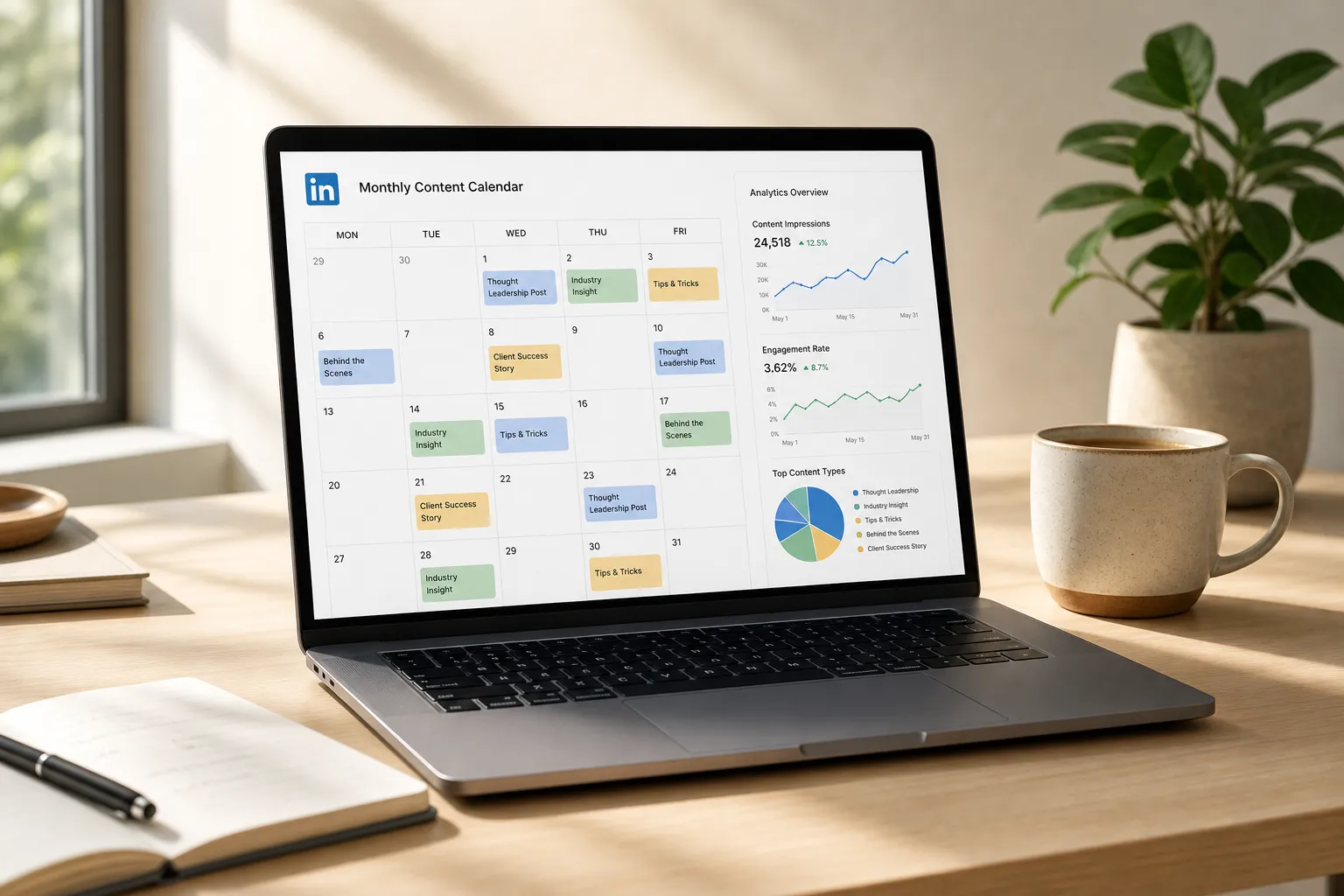
- Calendar. Open LiFast’s content calendar and schedule for the week. Example cadence: Mon teaching, Tue story, Wed magnet, Thu mini teardown, Fri hot take. Post at the time your audience engages most based on last 30 days of analytics.
- Assets. If a post includes short video, add burned-in captions and tight on-screen structure so it is scannable without sound. Use auto captions for TikTok and YouTube with styling and translation, then upload the native video with your copy inside LinkedIn.
One-pass QA checklist
- Voice. Would a follower recognize this as you by line two. If not, rewrite the opener or swap in a known hook pattern.
- Claim and proof. Every claim gets one proof point. Use a number, a timestamped screenshot, or a brief customer vignette. Remove vague adjectives.
- Clarity. Replace jargon with buyer language from audience analysis. Cut filler. Each sentence should carry new information.
- Structure. One idea per post. Put the payoff in the first three lines. End with a clear next step.
- Compliance. Strip internal data you cannot share. Avoid promises you cannot meet. Sanity-check magnet links and access settings.
When a draft passes QA, schedule it. If one section is weak, regenerate only that paragraph or hook. Do not rewrite the whole post.
Measure and improve
Automation compounds only with feedback. Use LiFast’s analytics to see which pillars, hooks, and CTAs drive saves, comments, clicks, and opt-ins. Pair that with the lead tracking dashboard to attribute meetings and pipeline back to specific posts and magnets.
What to watch
- Hook resonance. Save rate on text posts and average watch time on video indicate clarity. Early-stage B2B accounts should target a 1–2 percent save rate on non-viral posts.
- Conversation quality. Comment depth and meaningful replies beat raw likes. Track the share of comments from ICP titles and the percent that include a question or next-step ask.
- Magnet efficacy. Aim for 0.8–1.5 percent opt-in rate per impression on magnet posts. Downstream, 10–20 percent lead-to-meeting is healthy for high-intent magnets.
- Click intent. If you use links, watch click-through rate and dwell time. If you do not, track reply-to-DM rate when you offer to send a resource.
- Cadence health. Missed post days often correlate with a lead dip 10–14 days later. Guard the batching block and templates to prevent skips.
Quarterly, prune pillars that underperform and double down on the two that create the most pipeline. Update your prompt library with the top three hooks, one new proof angle, and a refined CTA. Archive formats that never clear your benchmarks.
Common pitfalls
- Too many topics. Five pillars is a ceiling. More fragments authority and muddles analytics. Merge or cut until each pillar gets weekly coverage.
- Over-automation. AI drafts fast, but you set the judgment. Add one specific example or number to every post before scheduling.
- Weak CTAs. Teaching without a next step leaves demand on the table. Ship one strong magnet each week and tell readers exactly what they get.
- Style drift. If a post does not sound like you, update the voice instructions and regenerate sections. Add a banned-words list to tighten tone.
- Ignoring accessibility. Uncaptioned videos lose attention. Add concise on-screen structure and captions every time.
Key takeaways
- Define 3–5 buyer-led pillars and map them to weekly publishing so you never run out of relevant topics.
- Use prompt modules for hook, point of view, proof, CTA, and format to scale quality without bloat.
- Batch a full week in one sitting. Generate posts and one magnet, then schedule and approve with a single QA pass.
- Route all magnet signups through LinkedIn lead capture into LiFast’s lead tracking dashboard for clean attribution.
- Inspect analytics weekly. Promote what converts to meetings, prune what does not, and update prompts based on results.
With a focused workflow and LiFast handling generation, magnets, scheduling, analytics, and lead capture, your LinkedIn program runs like a system. Review takes minutes, posts keep publishing, and your team stays in conversations that turn into pipeline.
Ready to automate your LinkedIn marketing?
LiFast generates posts, creates lead magnets, and schedules your content calendar on autopilot.
Get Started Free